Mob Era: Age Evolution
- 4.5
- Rating
- 1.00M
- Installs
- Free
- Price

 Analysis by App-foxy
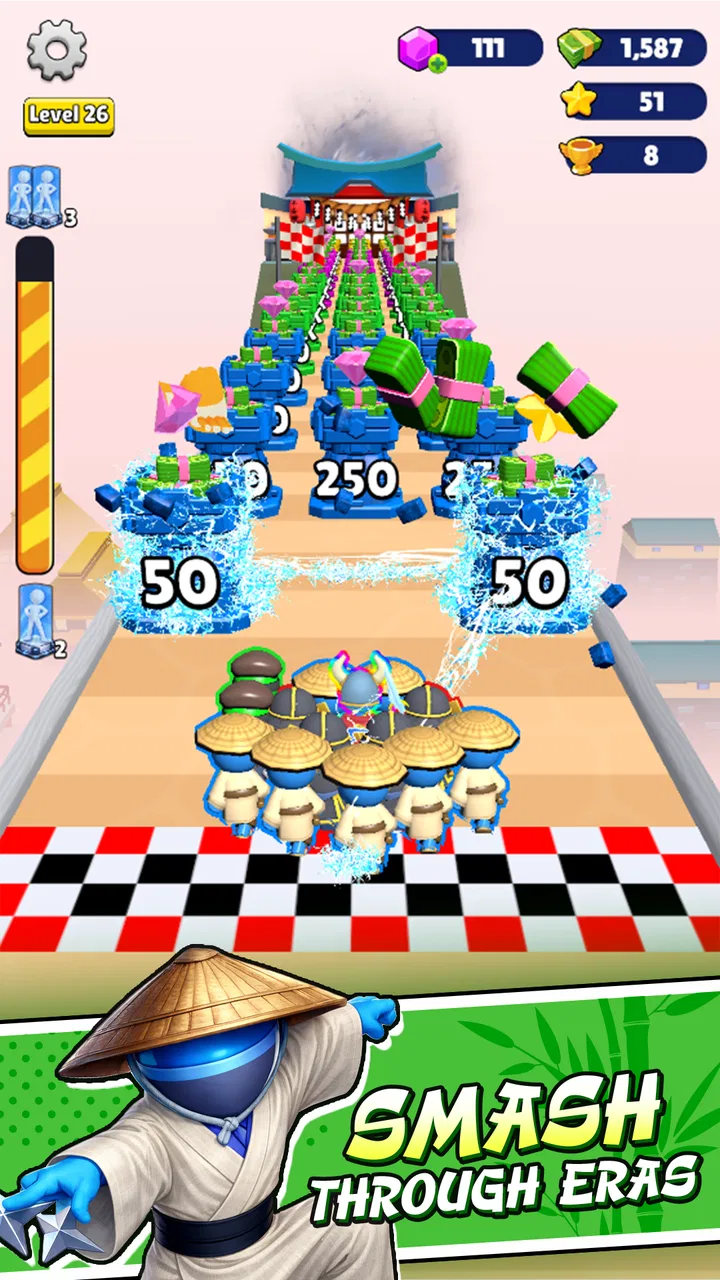
I spent time with Mob Era: Age Evolution as a quick-action game built around movement, growth, and conquest. Its central appeal is easy to understand: I guide a group through changing eras, collect more strength along the way, and try to finish each run with enough momentum to overcome what stands ahead. That makes it approachable from the first minute, especially when I want something more immediate than a long strategy session.
What makes it worth discussing is not just the idea of running forward. The interesting part is how the game turns small decisions into a feeling of progress. Every choice about where I move, what I collect, and how aggressively I approach a challenge affects the shape of the run. It is a free action title from Horusent Sing, rated for Everyone, and I found it most enjoyable when I treated each attempt as a short experiment rather than expecting a deep campaign with extensive management.
The game is currently at version 0.0.2.3 and supports devices running Android 7.0 or later. Its average score is 4.5 from roughly fourteen thousand ratings, with more than half a million installs, so it has already attracted a sizeable audience for a relatively compact experience. Those figures suggest that the simple action-and-evolution formula is connecting with many players, but they do not remove the need to decide whether its style fits your household, your attention span, or the way you share a device.
You May Also Like

 Blood Strike: 2.5 Anniversary
Blood Strike’s Loadouts Turn Every Drop Into a Tactical Gamble
A close look at Blood Strike’s custom loadouts: how fast access to signature weapons reshapes its battle royale rhythm, rewards preparation, and narrows the gap between fights.

 Pandora - Music & Podcasts
Pandora’s Music Is Easy to Start, but Harder to Recover
Pandora’s strength is its low-effort path from a seed to a station. Its weak spot is how much confidence it asks you to place in connection, setup, and quiet recovery.

 8 Ball Pool
 Is Built on Rivalries, Rematches, and Routine
A close look at the rivalries, rematches, shared routines, and unanswered safety questions that turn a quick pool match into a persistent mobile community.

 Samsung Music
’s Quiet Strength Is Playing What You Already Own
Its reach comes less from spectacle than from dependable access to a personal library. That simplicity is both the app’s strongest retention engine and its ceiling.

 AccuWeather: Weather Radar
AccuWeather Review: A Quick, Clear Forecast for Everyday Decisions
For everyday plans, the best forecast is the one you can understand quickly. AccuWeather makes rain timing, radar, and local conditions easy to act on, with a few trade-offs.

 Hill Climb Racing
Why Hill Climb Racing Still Turns Crashes Into One More Run
A tiny car, a bumpy hill and one more upgrade: Hill Climb Racing keeps resurfacing because its simple chaos makes every near-miss feel personal.
More From Our News Desk
View All News


How the shared-device experience actually feels
In a household where one phone or tablet passes between people, this is the kind of game that is easy to demonstrate. I can hand over the device after a run and explain the basic goal without needing a long tutorial conversation. Someone watching can understand the visual feedback quickly: the group moves, the situation changes, and the result of a decision is visible almost immediately.
That simplicity is useful when a younger player wants to try it after seeing an older sibling play. The game does not require a long explanation of a complicated economy before the first meaningful action. I would still stay nearby for the first few attempts, not because the premise is difficult, but because a new player benefits from learning to look ahead instead of reacting to every object at the last second.
A realistic household use case is a short turn while waiting for dinner or during a quiet break. One person plays a run, then another tries to beat that result by choosing a different route or handling a difficult section more carefully. This creates a light form of coordination without requiring several devices or a formal multiplayer setup. The important boundary is that this is shared-device play, not something I would describe as a built-in family competition system.
That distinction matters. If you are looking for a game where several household members can join the same live session, communicate inside the match, or maintain separate connected profiles, this is not the experience I would choose based on what I played. Its strength is the quick handoff: play, finish, discuss what happened, and pass the device along.
I also found that the game works better when each player agrees on a simple goal before starting. One person may focus on collecting as much as possible, while another may care more about reaching the end safely. Because those priorities can lead to different choices, the device becomes a small decision-making exercise rather than just a reflex toy. That is one of the more useful ways to make repeated runs feel less repetitive in a shared setting.
What to establish before handing over the device
My first recommendation is to decide who is using the device and for how long before opening the game. The action is accessible enough that a player can become absorbed in repeated attempts, especially after a near-success. A simple turn limit avoids the familiar household argument where “one more run” quietly becomes a much longer session.
I would also check the device’s general purchase settings before letting a child play. The game is free to download, but it includes optional purchases ranging from $0.99 to $49.99 per item. I do not treat that as a reason to avoid it, yet it is a practical reason to keep payment approval under the device owner’s control. The safest arrangement is to make sure a child cannot complete a purchase casually while trying to continue playing.
This is especially important on a shared tablet, where several people may use the same store account. The game itself can be passed around easily, but the account connected to the device is a separate matter. I would not assume that a player understands the difference between an in-game prompt and a free action. Before sharing, I would explain that any purchase requires the owner’s permission, even if the game does not appear to demand money during ordinary play.
Another useful boundary is to decide whether the game is for independent play or for supervised turns. Because it is rated Everyone, I see it as broadly suitable for a general audience, but an age label does not replace a parent’s judgment about spending, screen habits, or frustration. A younger player may enjoy the colorful forward motion while still needing help understanding why a particular choice caused a run to fail.
There is also a practical device boundary. The minimum operating-system requirement is Android 7.0, which covers many older Android devices, but compatibility should still be considered alongside available storage, battery condition, and who else relies on the phone. I would avoid installing it on a shared work device or a phone needed urgently for calls if repeated play could make the device unavailable at an inconvenient moment.
Coordinating turns without turning it into a chore
The easiest household routine is to use a visible order: one player starts, everyone watches if they want to, and the device moves on after the run ends. That works better than taking the phone away at an arbitrary moment because the game’s action is organized around attempts. Ending at a natural stopping point feels fairer and lets the next person begin with a clean objective.
For children who are still learning to make choices under pressure, I would encourage an adult or older sibling to ask questions rather than take control. “What are you trying to collect?” or “Which direction looks safer?” helps the player develop a habit of reading the path. Taking the device and solving the section for them may produce a better result, but it removes the useful part of the game: learning from the consequence of a decision.
Older players can add a friendly challenge by comparing approaches rather than only comparing outcomes. One run can prioritize growth, another can prioritize caution, and the household can discuss which style felt more reliable. This is a small but meaningful advantage over games that reduce every session to a single score with no visible reason for the result.
I would avoid presenting the game as a serious test of skill when a younger player is involved. The run-based structure naturally creates failure, and a child may interpret repeated losses as personal failure rather than as part of the loop. A better approach is to treat each attempt as a way to learn the route and the timing. That framing keeps the atmosphere cooperative even when only one person is holding the device.
For a shared phone, account coordination is just as important as turn coordination. I would not let different players make purchases, change device settings, or assume that progress belongs to a separate personal profile unless the device clearly provides that separation. If several people use one installation, the sensible expectation is that the game is being played in one shared environment. That may be fine for casual turns, but it is less suitable for a household that wants private, independent progression.
Age, trust, and the limits of a general rating
The Everyone rating makes the game easier to consider for mixed-age households. I did not approach it as a mature or story-heavy action title; the emphasis is on movement, collecting forces, evolving, and overcoming obstacles. That broad tone is a good match for a parent who wants a simple action game that can be explained without discussing intense themes.
Still, trust should be handled in layers. A child may be trusted to play independently but not to approve spending. Another player may be trusted with the device but not with changing the account used for downloads. These are household decisions rather than gameplay features, and separating them prevents the age rating from being mistaken for a complete supervision plan.
I would also consider a child’s tolerance for repetition. The game’s appeal comes from trying again, adjusting a decision, and pushing farther. That loop can be satisfying for a patient player, but it may frustrate someone who wants a clear story conclusion or a calm experience with no pressure to react. In that situation, a puzzle game with slower pacing or a creative game with fewer failure points might be a better choice.
For an older player, the age rating should not be read as a criticism of depth. It simply signals broad accessibility. I enjoyed the immediate feedback, but I would not choose this as my main game if I wanted complex unit management, a large narrative, or a long-term competitive ladder. Its value is concentrated in short action sessions, not in replacing a full strategy or role-playing game.
Trust also includes knowing when to stop. Because the game encourages another attempt after a disappointing result, it is easy to continue chasing a better run. In a family setting, I would use a timer or a fixed number of turns when sleep, homework, meals, or shared device access matters. That is not a flaw unique to this title, but the quick restart structure makes the boundary worth setting in advance.
Where it stands beside other action games
Compared with a traditional arcade game, this one gives the player more of a sense of building momentum. I am not only trying to survive a moment; I am watching the group develop through the run. That evolution theme gives ordinary movement a clearer purpose and makes collecting feel connected to the final outcome.
Compared with a full strategy game, however, the decisions are much lighter. I would not open it expecting a map to manage, a complicated roster to optimize, or a long sequence of diplomatic choices. The advantage is speed: I can understand the immediate objective quickly and get into action. The trade-off is that players who enjoy planning several stages ahead may eventually want something with more systems to explore.
It also differs from competitive multiplayer action games because the main challenge is personal improvement rather than direct conflict with another household member. That makes it less stressful for casual players and easier to share with a child, but it also means there is no substitute for a genuine multiplayer game if live interaction is the main reason you are downloading one.
Against idle or automatic progression games, Mob Era feels more hands-on. I need to pay attention to the run instead of simply collecting rewards at intervals. That is a strength when I want a game that respects a short burst of focus. It is a weakness when I want something to leave running in the background while I do something else.
The purchase structure is another point of comparison. Since the game is free to start and offers optional items, I would treat it as a try-before-you-commit download rather than assume that every part of the experience is permanently free of spending prompts. Players who prefer a completely paid-up-front game may feel more comfortable with a different model, while families can use device-level approval habits to keep the free download within a controlled budget.
Small techniques that make repeated runs better
My first practical tip is to avoid steering by instinct alone. When the group is moving quickly, I found it tempting to chase the most obvious collection immediately. A better habit is to glance at the next decision before committing. That extra moment can prevent a short-term gain from creating a worse position later in the run.
Second, use early attempts as route-reading sessions. Instead of trying to win every time, pay attention to where the run becomes difficult and remember what choice led there. This makes the next attempt more deliberate. It is particularly useful when coaching a child, because the player learns to connect action and consequence rather than simply copying someone else’s movements.
Third, separate experimentation from score chasing. On one attempt, try a riskier approach to understand what it does. On the next, use the safer pattern you learned. Mixing both goals in every run can make a failure feel confusing because you do not know whether the problem was the plan or the execution. Treating runs as small tests gives the game more variety without requiring additional modes.
A fourth insight is to use the game as a conversation starter on a shared device. Ask the next player what they would change before they begin, then let them try their own idea. This turns the handoff into coordination rather than passive waiting. It also keeps adults from dominating the experience when a younger player needs room to develop confidence.
Finally, I would keep purchase decisions completely separate from gameplay decisions. A difficult run can make an optional item seem more appealing, especially when frustration is fresh. Waiting until the session is over before considering any purchase creates a useful cooling-off period. In a household, that rule is simple, fair, and easier for children to understand than trying to judge each prompt in the moment.
Who should install it, and who should pass
I recommend this game to someone who wants accessible action, quick attempts, and a visible feeling of growth without learning a large set of systems first. It is a particularly good fit for a shared phone or tablet where players can take turns and discuss different approaches. The broad age rating and straightforward premise also make it easier to introduce across generations.
I would be more cautious if your priority is private progression for several people on one device. Shared play is easy, but shared access does not automatically mean separate boundaries. If each household member needs a distinct identity, independent purchases, or a carefully protected personal save, I would look for a game and device setup designed around those needs.
I would also skip it if you want a deep action campaign, a strong narrative, or live multiplayer coordination. The game’s appeal is concentrated in its compact action loop. That is precisely why it works well during a short break, but it also means it may feel limited beside a larger console-style experience or a strategy game with extensive long-term planning.
Players sensitive to optional spending should not panic about the free entry point, but they should prepare the device responsibly. The purchase range is wide enough that I would never hand over a shared account without checking approval settings first. For a household that already has clear rules around app purchases, this is manageable; for one that does not, the friction may outweigh the fun.
My household verdict
After playing it, I see Mob Era as a friendly, compact action game that works best when its limits are understood. It gives me an immediate reason to move, collect, adapt, and try again, while remaining simple enough to explain to another person in the room. That combination makes it a natural candidate for short shared-device sessions.
Its strongest household quality is the ease of handoff. A parent, sibling, or friend can watch a run, suggest a different approach, and take a turn without needing to learn an elaborate rulebook. The best sessions are not about proving who is the superior player; they are about comparing choices and helping the next person understand what the previous attempt revealed.
Its main friction points are equally clear. Repetition may not satisfy players looking for a large campaign, the action is not a replacement for genuine multiplayer, and optional purchases mean the device owner should establish spending boundaries. Those are not reasons to dismiss it, but they are important when choosing a game for children or for a phone used by several people.
For me, the final recommendation is positive with conditions: install it if you want a free, approachable action game for short runs and informal household turns, and use it as a shared activity rather than promising separate personal accounts or deep strategic progression. The best way to enjoy it is to pair its quick evolution loop with clear device and spending boundaries. That keeps the focus on experimenting, improving, and passing the next run to someone else.
FAQs for Mob Era: Age Evolution
01What is Mob Era: Age Evolution about?
Mob Era: Age Evolution is a strategy game where players build and expand their own civilizations through different historical eras. Starting with basic resources, you must evolve your society technologically and militarily to dominate opponents and achieve supremacy. The game combines strategic planning with resource management, offering a rich and immersive gameplay experience.
02Is Mob Era: Age Evolution free to play?
Yes, Mob Era: Age Evolution is free to download and play. However, it does offer in-app purchases that allow players to buy resources or unlock special items to enhance gameplay. While these purchases can speed up progress, they are completely optional, and the game can be enjoyed without spending money.
03What are the device requirements for Mob Era: Age Evolution?
Mob Era: Age Evolution requires a device running on Android 5.0 or iOS 11.0 and above. The game is optimized for both smartphones and tablets, but for the best experience, a device with at least 2GB of RAM and a stable internet connection is recommended to ensure smooth gameplay and quick loading times.
04Can I play Mob Era: Age Evolution offline?
No, Mob Era: Age Evolution requires an internet connection to play. The game features a dynamic world where players interact with each other in real-time, which necessitates being online. This connectivity ensures that players receive regular updates, participate in events, and engage in multiplayer battles or alliances.
05How does multiplayer work in Mob Era: Age Evolution?
In Mob Era: Age Evolution, multiplayer interaction is a core element. Players can form alliances, trade resources, and engage in battles with others worldwide. The game encourages strategic cooperation and competition, allowing players to join forces to conquer new territories or defend against aggressive opponents. Communication tools within the game facilitate coordination and strategy planning.
Pros
- Engaging gameplay with historical themes.
- Smooth graphics enhance visual experience.
- Variety of challenges to keep players hooked.
- Regular updates with new content and events.
- Intuitive controls make navigation easy.
Cons
- In-app purchases can be quite costly.
- Requires constant internet connection.
- Occasional bugs disrupt gameplay.
- Ads can be intrusive and frequent.
- Game progress can be slow without purchases.

Mob Era: Age Evolution
Gallery